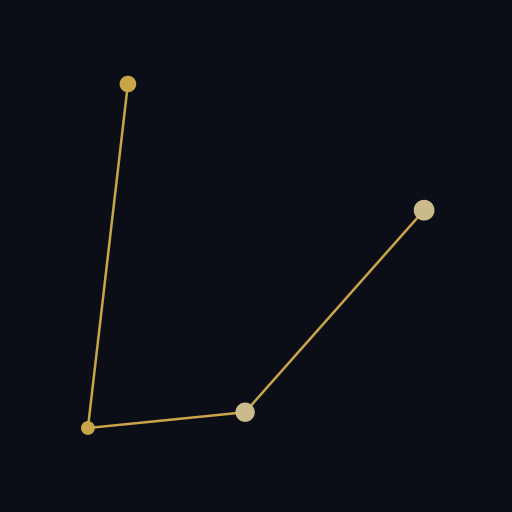
 Vela
Vela 
The second decan of Leo is 10° to 20° of the sign, the sign in its fuller, more settled middle register. In the classical face system this stretch is sub-ruled by Jupiter, a second planet laid over Leo's own ruler, Sun. A decan never changes the sign, it tones it: here the Leo nature carries a Jupiter accent, opening it toward meaning, generosity, and the reach for something larger.
- Sign
- Leo, the sovereign
- Decan
- Second face (10° to 20°)
- Face ruler
- Jupiter, meaning
- Element
- Fire
- Modality
- Fixed
The Jupiter face of Leo
Leo is the sovereign, fire by element and fixed by mode. Its Jupiter face adds reach and the hunger for meaning, so a Leo of the second decan tends to keep the Leo temperament while leaning, more than the sign's other two faces do, toward meaning: growth and faith. Think of it as Leo read in a Jupiter key.
If this decan is yours, where do you recognise the Leo in you carried with a Jupiter accent, and where the reach for more has become a way of avoiding enough?
The other decans of Leo
Leo also holds the first decan, the Saturn face and the third decan, the Mars face. See the Leo zodiac sign in full, read today's Leo horoscope, or explore all thirty-six decans.
Frequently asked
What is the second decan of Leo?
The second decan of Leo is 10° to 20° of the sign, the sign in its fuller, more settled middle register. In the classical face system this stretch is sub-ruled by Jupiter, a second planet laid over Leo's own ruler, Sun. A decan never changes the sign, it tones it: here the Leo nature carries a Jupiter accent, opening it toward meaning, generosity, and the reach for something larger.
Who rules the second decan of Leo?
The second decan of Leo (10° to 20°) is classically sub-ruled by Jupiter, laid over Leo's own ruler, Sun.
What are decans in astrology?
Each zodiac sign spans thirty degrees, divided into three decans of ten degrees. Each decan is sub-ruled by a classical planet in the Chaldean order, giving that stretch of the sign a second tone. They are read as a lens for reflection, never a prediction.